LYB, Armando Alvarez Group advance bio-circular solutions in industrial packaging at Wesseling
Sustainability progress is most meaningful when it becomes part of everyday operations.
At the LyondellBasell (LYB) Wesseling site in Germany, teams are collaborating with the Armando Alvarez Group (AAG), a long-standing customer with deep expertise in industrial flexible packaging, to implement bio-circular solutions in a practical way. This collaboration demonstrates how bio-circular materials can be integrated into daily operations without compromising safety or performance.
Collaboration in practice
Working closely with AAG, the Wesseling site is using Form-Fill-Seal (FFS) bags with attributed bio-circular content, certified under ISCC+ standards. This collaboration brings together material expertise and packaging know-how to support more sustainable industrial packaging applications.
Rather than treating sustainability as a standalone initiative, this approach shows how it can be embedded directly into operational processes — from packaging to delivery — while meeting the performance and safety expectations customers rely on.
How it works
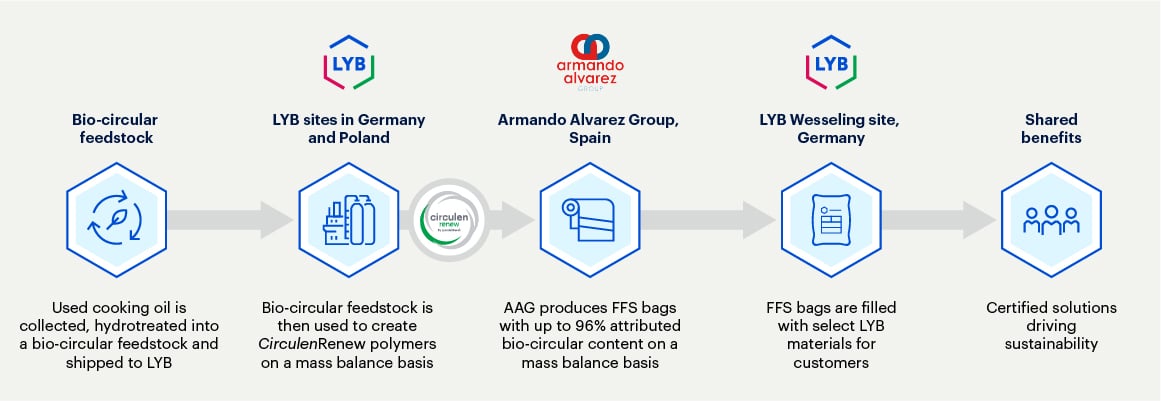
- LYB supplies CirculenRenew polymers sourced from bio-circular feedstock to AAG
- AAG produces Form-Fill-Seal (FFS) bags with up to 96% attributed bio-circular content, applying an ISCC+ certified mass balance approach
- The Wesseling site then uses those bags to package and deliver select materials to customers
This approach allows teams to gain real-world experience while continuing to learn and refine practical applications of bio-circular solutions.
Why it matters
By integrating these solutions into everyday operations, the collaboration supports:
- Progress toward lower carbon outcomes, as CirculenRenew polymers offer up to 44% lower product carbon footprint (PCF) on a cradle‑to‑gate basis compared to fossil‑based alternatives1
- Traceability through third-party ISCC+ certification of the mass balance approach
- Ongoing learning across teams and partners
Most importantly, it shows how strong relationships and technical expertise can translate sustainability ambition into real operational application.
Moving forward
This collaboration shows the possibilities when collaboration meets everyday execution — taking small but important steps forward across the value chain.
1 The cradle-to-gate PCF reduction is based on a comparison of EU life cycle assessment (LCA) results that exclude emissions from activities downstream of the LYB factory gate, including emissions associated with transport, distribution, use and end of life waste management. Biogenic emissions are also excluded from this comparison