GPCA Annual Forum: CEO discusses LYB transformation, 2025 reflections and market enablers
CEO Peter Vanacker spoke at the 19th edition of the Gulf Petrochemicals and Chemicals Association (GPCA) Annual Forum held in Manama, Bahrain, Dec. 8-11. His remarks offer reflections on the strategic transformation underway at LYB, the state of the industry in 2025 and explore what can enable value creation over the mid- to long-term.
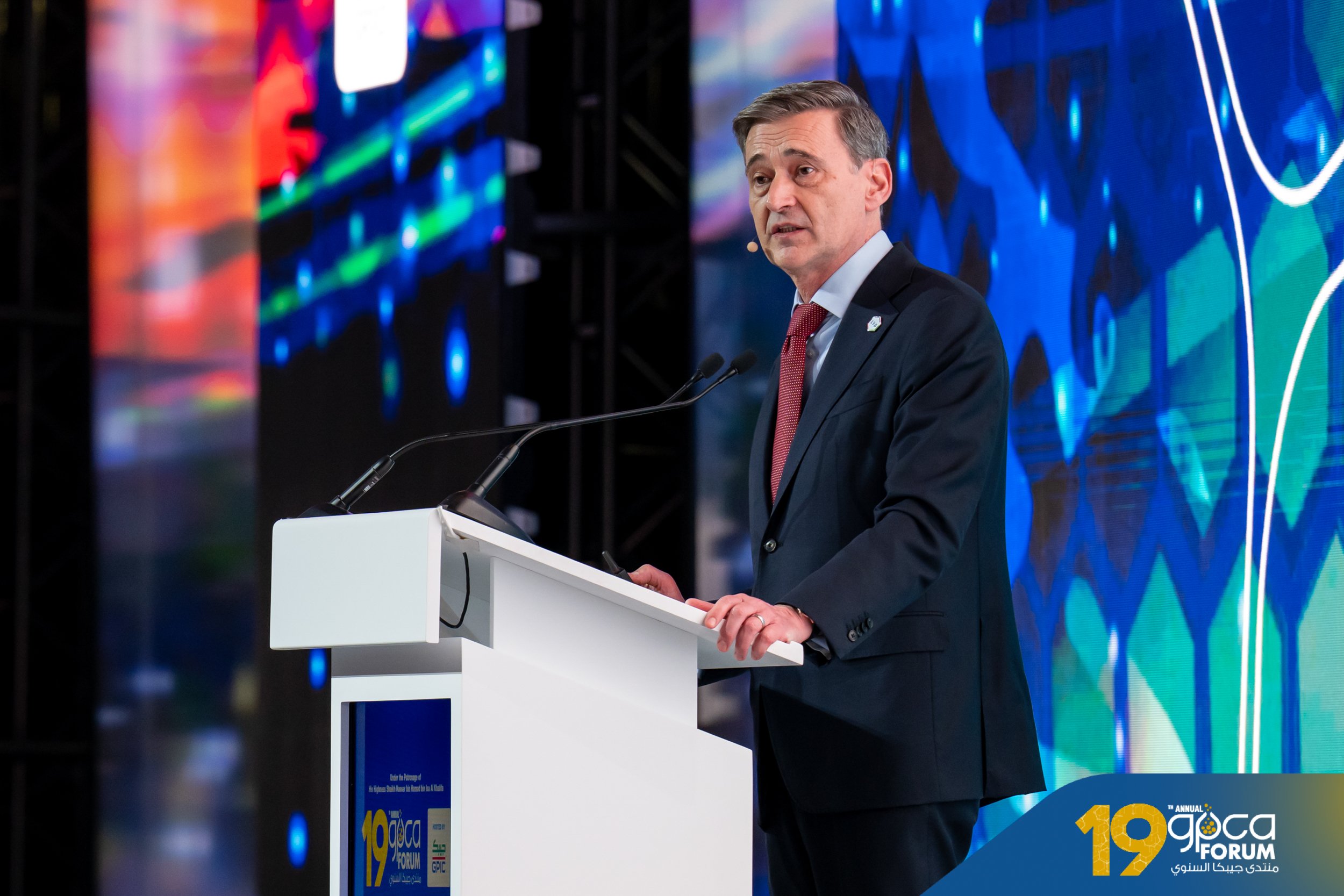
Good morning, your royal highnesses, excellencies and honored guests:
I would like to thank GPCA Secretary General Al-Sadoun and his team for inviting me, as well as the Kingdom of Bahrain for hosting such an important event.
Forums like these inject much-needed perspective around the defining issues of our time. In that vein, I’d like to offer a few macro observations.
Like many of you, I have lived through several chapters of our industry’s evolution, but only a few have been as multifaceted and rapidly changing as the one currently underway.
We live in a time of structural transformation. The fast-paced combination of geopolitical change, trade rules, shifting policy landscape and realignment of world powers represents a challenge unlike few others ― but one no less ripe with opportunities.
I am talking about opportunities to generate shareholder value by adapting how we do business, yet without losing sight of long term fundamentals. In specific:
- population growth continues apace;
- a rising middle class ― especially in the developing world ― is expanding; and
- we are an industry of serial innovators. We are advancing the properties of our core materials, as well as delivery of more sustainable solutions to address global challenges around waste management, natural resources and climate change.
Despite the challenges industry is facing, these trends are enduring, and represent opportunities to generate meaningful and lasting value.
Opportunities to establish new collaborations, reset relationships otherwise needing to improve, and refocus efforts to succeed in the next upcycle.
Invariably, various organizations will pursue different and often divergent pathways.
While I believe the current landscape will significantly change our industry, I am confident those who succeed will demonstrate they can adapt faster and evolve in line with the structural changes which confront us.
When it comes to LYB, we believe the previously-described fundamentals will continue to propel our disciplined strategy to reward shareholders and earn the right to grow.
Even while navigating challenging market conditions, we continue to see opportunities to address growing demand for our products in attractive markets aligned with our core.
We are taking swift, decisive action to realign our business with regions and markets catering to different value propositions.
In our business context, the Middle East and North America are foundational to our success. They provide:
- competitive raw materials and energy costs;
- a skilled workforce;
- access to growing markets; and
- the entrepreneurial mindset to foster innovation, which will offer customers world-class materials while reducing greenhouse-gas emissions, enabling circularity and value creation.
Cross-border ventures in these regions play a critical role for LYB. They provide a pathway to value creation, as well as the potential to embed sustainable practices in the business long term. Our experience shows these ventures can offer effective ways to manage risk and maximize how each JV partner can contribute value.
In the Middle East, we already have a longstanding presence with well-respected joint-venture partners, many of whom I am pleased to see here today.
We also have further projects under consideration with other great partners to leverage our technological strengths, along with competitively-priced feedstocks, to generate more stable earnings and support future innovation.
At the same time, in the current capital-constrained environment, we recognize continued growth across strategic regions depends on:
- market conditions;
- timing; and
- successful execution of our regional joint venture plans.
These considerations reflect our commitment to thoughtful and strategic repositioning, not rapid expansion. Our goal is to establish lasting ventures through regional diversification, a process which can generate value while proving resilient against inevitable market cycles.
The same applies to our approach to developing sustainable solutions. We are very deliberate in where, when and how we expand ― and recognize what works in one market may not in others.
At LYB, we believe in an all-of-the above approach to create value ― benefiting both shareholder returns and sustainable innovation.
A prime example is our investment in our proprietary, catalytic chemical recycling technology, MoReTec. This project is a critical component of our ecosystem of circular and renewable-based solutions in Germany, and we believe will prove plastics circularity does work.
Alongside the planned optimization of our EU asset base, projects like this embody our region-specific approach to cater to growing consumer demand in higher-margin businesses within mature markets for sustainable solutions.
When markets recover, we are confident we will see margins for circular and renewable-based solutions grow considering the tightness of supply.
After all, the market for these solutions is still in its early stages, and consumer demand remains strong ― which is why the ability to maintain an early-mover advantage in this segment is paramount before it reaches critical mass.
Global infrastructure for plastic waste collection and sorting is not even close to reaching sufficient scale to create a market for more sustainable products ― I know the team at the Alliance to End Plastic Waste, among others, is working very hard in this respect.
More broadly, the establishment of solutions-oriented policies focused on pragmatism and new opportunities is essential to facilitate progress in this space. As it happens, progress is not often linear when it comes to plastics policy. The lack of a concrete outcome from the latest United Nations negotiations to pass a global plastics agreement reflects as much.
I am thankful to the Kingdoms of Bahrain and Saudi Arabia, as well as the State of Kuwait, which, among other GCC nations, have been strong supporters to establish a workable agreement. Together with them and other likeminded nations, we must continue to advocate for an international agreement to help end plastic pollution.
An effective UN agreement would include globally agreed-on measures, yet tailored and enacted by regional governments to match local realities. Those measures should:
- prioritize proper waste management;
- inform criteria for product design;
- promote recycled content targets based on application-specific considerations at the country level;
- incorporate financing mechanisms, including producer responsibility or similar systems; and
- enable trade of waste through sound and capable management systems.
I’d also like to call out the policies we have been long advocating for to support the chemical industry across the board by engaging in advocacy ranging from local to international. These policies do not just focus on plastics but on improving the overall functioning of our industry. They include:
- government support and commitments to manage the energy and material transition;
- regulations that stabilize and expand electricity price compensation, funding for hydrogen, carbon capture and storage, in addition to capacity and grid build-up;
- policies which stimulate demand for sustainable and circular materials;
- many companies in our sector are ambitiously committed to climate protection, and we are already investing in low-carbon technologies and energy efficiency. We need a reliable pathway that covers 20 years to ensure confidence in the required huge investments companies would underwrite; and
- legal recognition of technological innovations like chemical recycling and related traceability mechanisms, including mass balance.
Enacting these policies could provide much-needed momentum to reposition relationships between industry and governments toward a more mutually beneficial footing grounded in realistic ambitions.
When it comes to the Middle East, we see positive signs for longer-range opportunities for carbon reduction and product innovation. Policy frameworks like the Kingdom of Saudi Arabia’s Vision 2060 offer promising pathways to enable markets for our core products, in addition to scaling up supply of sustainable offerings.
Obvious though it may sound, the picture is not as positive everywhere.
We remain concerned by risks posed by policy environments like in the EU, as the region faces mounting challenges to its competitiveness ― across its economy and in petrochemicals.
EU leaders must take immediate action to ensure the economic viability of energy-intensive industries. Europe risks further deindustrialization, job losses and weakened climate leadership so long as its policymaking remains detached from market realities.
Recent asset rationalizations aren’t just part of a challenging-but-necessary market rebalancing, but also a result of unintended consequences from policymaking mostly driven by ideology.
A prime example of this kind of policymaking includes EU policies tied to ETS, as in the bloc’s emission trading system reduction path, and implementation of a carbon border adjustment mechanism, CBAM.
Both ETS and CBAM pose significant risks to our competitiveness since they mandate targets and associated costs, which do not properly consider how global economies work together.
We prefer a pragmatic, partnership-based approach, which aligns climate ambition with industrial strength — ensuring Europe remains a global leader in manufacturing and sustainability. We call on Europe to:
- extend free ETS allocation beyond current phase-out dates; and
- suspend CBAM-related phase-outs and avoid expanding its scope prematurely, otherwise all we will have is an even more rapidly-deteriorating economic environment.
While dialogue is underway to attempt to find region-specific solutions, it is incumbent for us as leaders to diversify our market presence to fulfill our mandate of being responsible stewards of shareholder capital and our companies’ competitive advantage.
In this regard, we are encouraged to see GCC states not making the same policy mistakes and instead driving smart choices to prosper in the long-term, by facilitating investment and innovation.
As I approach the conclusion of today’s remarks, I’d like to reiterate a few points:
It is clear we are witnessing sizable market shifts, which require regionally-diversified strategies, supportive policies and cross-border collaborations.
Worldwide, our company and industry continue to innovate and perform essential roles in meeting the needs of a growing world population for petrochemicals produced safely, reliably and sustainably.
Yet, growth and innovation must always tie into value creation. We must ensure shareholders see returns on invested capital and prove our strategies can overcome uncertainty amid a changing global landscape.
These are the market realities we must address, not in a vacuum but alongside shareholders and policymakers, and I look forward to exploring these themes further with you all.
Thank you.